IndianHandicrafts,http://www.readbooksonlinebynamrata.blogspot.com

The history of Indian handicrafts goes back to almost 5000 years from now. There are numerous examples of handicrafts from the Indus Valley Civilization. The tradition of crafts in India has grown around religious values, needs of the common people and also the needs of the ruling elites.

historical places in India

India is 7th largest country located in south asia and 2nd largest country by population. India is consisting of 28 states and four major religions Hinduism, Buddhism, Jainism and Sikhism. This post contains Historical Places of India. India is a diverse country steeped in history. Its past has seen a melting pot of different religions, rulers and empires -all of which have left their mark on the countryside. Many historical places in India are listed as World Heritage sites due to their cultural importance.

Beautiful Indian Art

Beautiful Indian Art

Indian Handicrafts

http://www.readbooksonlinebynamrata.blogspot.com.

Indian traditional dresses

Traditional Indian clothing for women are saris or gaghra cholis and (lehengas). They are considered beautiful clothes depending on the occasion. Saris made out of silk are considered the most elegant. Mumbai, formerly known as Bombay, is one of India's fashion capitals. In some rural parts of India, traditional clothing is worn. Women wear a sari, a long sheet of colorful cloth with patterns. This is draped over a simple or fancy blouse. This is worn by young ladies and women. Little girls wear a pavada. Both are often patterned. Bindi is part of the women's make-up. Indo-western clothing is the fusion of Western and Subcontinental fashion. Churidar, dupatta, Khara Dupatta, gamchha, kurta, mundum neriyathum, sherwani are among other clothes..

Facebook Badge

Showing posts with label Historical Places in India. Show all posts

Monday, 14 May 2012

Ajanta and Ellora Caves

Ajanta and Ellora Caves

ajanta_cave__readbooksonlinebynamrata_1

ajanta__readbooksonlinebynamrata_2


Ajanta and Ellora Caves: Very beautifully carved paintings on caves of Ajanta and Ellora, are a marvelous 
piece of art and history in India. With 34 caves which were painted between the 6th and 11th centuries AD. and there are 29 caves at Ellora, all beautifully architecture between 2nd century and 6th century AD.


The caves at Ajanta are famous for their rich paintings and sculpture, whereas the caves at Ellora are famous for their remarkable architecture.

Ajanta & Ellora Caves_readbooksonlinebynamrata_4

ajanta__readbooksonlinebynamrata_3


Ajanta and Ellora Festivals:

The four day Ellora Ajanta Festival is held at Soneri Mahal (Golden Palace), an historic 17th century architectural marvel in Aurangabad near Ellora, in the last week of November each year. The festival features some of the most distinguished singers and dancers of India.


ajanta-ellora_readbooksonlinebynamrata_6

ellora-cavesreadbooksonlinebynamrata_5


Ajanta caves are at a distance of 99 km from Maharashtra's Aurangabad district. It is believed that Ajanta caves started carving from 2nd century BC and ended at 6th century AD. The entire course of the evolution of Buddhist architecture can be traced in Ajanta. Images interpreting the life stories of Buddha and animal figures were carved out from the huge rocks. 


Everything including the contemporary people, kings, slaves, women, men and children are seen in the Ajanta wall paintings interlaced with flowers, plants, fruits, birds and beasts. There are also the figures of yakshas, kinneras (half human and half bird) gandharvas (divine musicians), apsaras (heavenly dancers), which were of concern to the people of that time.


Location: The caves are in northern Maharastra, around 400 kilometers (250 miles) from Mumbai


From Aurangabad: - Ajanta-100km, Ellora-30km
Built in:-Ajanta Caves (200BC to 650AD),Ellora (350AD to 700AD)
Discovered By: - John Smith in 1819
Best Time To visit :  Anytime of the year
Visiting Time : 9am to 5.30 p.m. The Ajanta caves are closed on Mondays, and the Ellora caves are closed on Tuesdays
How to reach : Nearest Railway Station to Ajanta Caves - Jalgaon, Nearest Railway Station to Ellora Caves - Aurangabad
Best Time To visit :  Anytime of the year

charminar_hyderabad_readbooksonlinebynamrata

Charminar

charminar at night_hyderabad_readbooksonlinebynamrata_2
charminar at night

charminar_hyderabad_readbooksonlinebynamrata_5
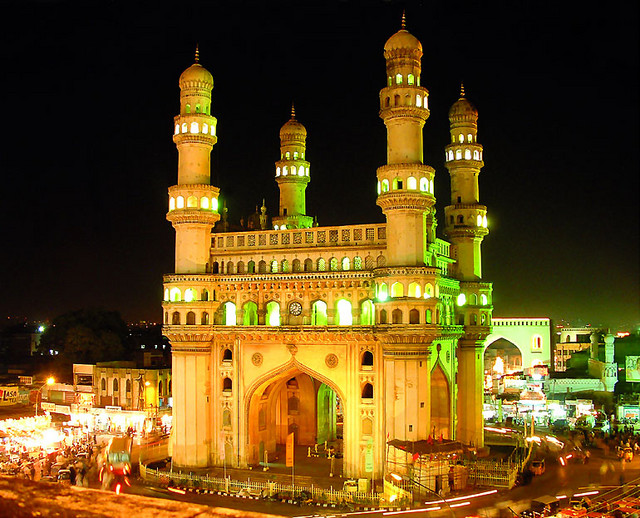
Charminar built in 1591  by Muhammed Quli Qutub Shah , is a landmark monument located in Hyderabad, Andhra Pradesh, India. The two words Char Minar of Urdu language are combined to which it is known as Charminar (English: Four Towers). These are four ornate minarets attached and supported by four grand arches, it has become the global icon of Hyderabad and is listed among the most recognized structures of India.The Charminar is on the east bank of Musi river.To the northeast lies the Laad Bazaar and in the west end lies the granite-made richly ornamented Makkah Masjid.This mascot of the city was built, in an Arabic style of architecture, with lime and mortar. Within the Charminar is a mosque. A temple is at the base of one of its minars. 
charminar_hyderabad_readbooksonlinebynamrata_1
Charminar is a beautiful and impressive square monument. Each side measures 20 m, and each of the corners has a tall, pointed minaret. These four gracefully carved minarets soar to a height of 48.7 m above the ground, commanding the landscape for miles around. Each minaret has four stories, marked by a delicately carved ring around the minaret. Unlike the Taj Mahal, Charminar’s four fluted minarets of Charminar are built into the main structure. Inside the minarets 149 winding steps guide the visitor to the top floor, the highest point one can reach, which provides a panoramic view of the city
charminar_hyderabad_readbooksonlinebynamrata_7


Entry Fee: Rs. 5 for Indian Nationals, Rs. 100 for Foreign
Video: Rs. 25
Timings: 9.00 am - 5.30 pm (Open all days) 

Wednesday, 2 May 2012

Beautiful Indian Art History With images

Beautiful Indian Art History With images


Beautiful Indian Art

 Indian Art-1


 Indian Art-2


Indian art evolved with an emphasis on inducing special spiritual or philosophical states in the audience, or with representing them symbolically. According to Kapila Vatsyayan, "Classical Indian architecture, sculpture, painting, literature (kāvya), music, and dancing evolved their own rules conditioned by their respective media, but they shared with one another not only the underlying spiritual beliefs of the Indian religio-philosophic mind, but also the procedures by which the relationships of the symbol and the spiritual states were worked out in detail."
In the Pan Indian philosophic thought the term 'Satyam Shivam Sundaram' is another name for the concept of the Supreme. 'Sat' is the truth value, 'Shiv' is the good value & 'Sundaram' is the beauty value. Man through his 'Srabana' or education, 'Manana' or experience and conceptualization and 'Sadhana' or practice, through different stages of life (Asramas) comes to form and realize the idea of these three values to develop a value system. This Value-system helps us to develop two basic ideas 1) that of 'Daksha' or the adept/expert and 2) of Mahana/Parama or the Absolute and thus to judge anything in this universe in the light of these two measures, known as 'Adarsha'. A person who has mastered great amounts of knowledge of the grammars, rules, & language of an art-form are adepts (Daksha), whereas those who have worked through the whole system and journeyed ahead of these to become a law unto themselves is called a Mahana. Individuals idea of 'Daksha' and 'Mahana' is relative to one's development of the concept of 'Satyam-Shivam-Sundaram.' For example, Tagore's idea of these two concepts should be way above any common man's and many perceive Tagore as a 'Mahana' Artist in the realm of literature. This concept of Satyam-Shivam-Sundaram, a kind of Value Theory is the cornerstone of Indian Aesthetics.
Of particular concern to Indian drama and literature are the term 'Bhava' or the state of mind and rasa referring generally to the emotional flavors/essence crafted into the work by the writer and relished by a 'sensitive spectator' or sahṛdaya or one with positive taste and mind. Poets like Kālidāsa were attentive to rasa, which blossomed into a fully developed aesthetic system. Even in contemporary India the term rasa denoting "flavor" or "essence" is used colloquially to describe the aesthetic experiences in films; "māsala mix" describes popular Hindi cinema films which serve a so called balanced emotional meal for the masses, savored as rasa by these spectators.
Rasa theory blossoms beginning with the Sanskrit text Nātyashāstra (nātya meaning "drama" and shāstra meaning "science of"), a work attributed to Bharata Muni where the Gods declare that drama is the 'Fifth Veda' because it is suitable for the degenerate age as the best form of religious instruction. While the date of composition varies wildly among scholars, ranging from the era of Plato and Aristotle to the seventh century CE. The Nātyashāstra presents the aesthetic concepts of rasas and their associated bhāvas in Chapters Six and Seven respectively, which appear to be independent of the work as a whole. Eight rasas and associated bhāvas are named and their enjoyment is likened to savoring a meal: rasa is the enjoyment of flavors that arise from the proper preparation of ingredients and the quality of ingredients. What rasa actually is, in a theoretical sense, is not discussed and given the Nātyashāstra's pithy wording it is unlikely the exact understanding of the original author(s) will be known.
The theory of the rasas develops significantly with the Kashmiri aesthetician Ãndandavardhana's classic on poetics, the Dhvanyāloka which introduces the ninth rasa, shānta-rasa as a specifically religious feeling of peace (śānta) which arises from its bhāva, weariness of the pleasures of the world. The primary purpose of this text is to refine the literary concept dhvani or poetic suggestion, by arguing for the existence of rasa-dhvani, primarily in forms of Sanskrit including a word, sentence or whole work "suggests" a real-world emotional state or bhāva, but thanks to aesthetic distance, the sensitive spectator relishes the rasa, the aesthetic flavor of tragedy, heroism or romance.


 Indian Art-3
The 9th - 10th century master of the religious system known as "the nondual Shaivism of Kashmir" (or "Kashmir Shaivism") and aesthetician, Abhinavagupta brought rasa theory to its pinnacle in his separate commentaries on the Dhvanyāloka, the Dhvanyāloka-locana (translated by Ingalls, Masson and Patwardhan, 1992) and the Abhinavabharati, his commentary on the Nātyashāstra, portions of which are translated by Gnoli and Masson and Patwardhan. Abhinavagupta offers for the first time a technical definition of rasa which is the universal bliss of the Self or Atman colored by the emotional tone of a drama. Shānta-rasa functions as an equal member of the set of rasas but is simultaneously distinct being the most clear form of aesthetic bliss. Abhinavagupta likens it to the string of a jeweled necklace; while it may not be the most appealing for most people, it is the string that gives form to the necklace, allowing the jewels of the other eight rasas to be relished. Relishing the rasas and particularly shānta-rasa is hinted as being as-good-as but never-equal-to the bliss of Self-realization experienced by yogis.


Indian painting
The earliest Indian paintings were the rock paintings of pre-historic times, the petroglyphs as found in places like Bhimbetka, and some of them are older than 5500 BC. Such works continued and after several millennia, in the 7th century, carved pillars of Ellora, Maharashtra state present a fine example of Indian paintings, and the colors, mostly various shades of red and orange, were derived from minerals. Thereafter, frescoes of Ajanta and Ellora Caves appeared. India’s Buddhist literature is replete with examples of texts which describe that palaces of kings and aristocratic class were embellished with paintings, but they have largely not survived. But, it is believed that some form of art painting was practiced during that time.

Indian painting& indian art
Indian paintings provide an aesthetic continuum that extends from the early civilization to the present day. From being essentially religious in purpose in the beginning, Indian painting has evolved over the years to become a fusion of various cultures and traditions. The Indian painting was exposed to Greco-Roman as well as Iranian and Chinese influences. Cave paintings in different parts of India bear testimony to these influences and a continuous evolution of new idioms is evident.

Indian traditional dresses

indian traditional dresses


indian traditional dresses


Traditional Indian gaghra cholis
Traditional Indian clothing for women are saris or gaghra cholis and (lehengas). They are considered beautiful clothes depending on the occasion. Saris made out of silk are considered the most elegant. Mumbai, formerly known as Bombay, is one of India's fashion capitals. In some rural parts of India, traditional clothing is worn. Women wear a sari, a long sheet of colorful cloth with patterns. This is draped over a simple or fancy blouse. This is worn by young ladies and women. Little girls wear a pavada. Both are often patterned. Bindi is part of the women's make-up. Indo-western clothing is the fusion of Western and Subcontinental fashion. Churidar, dupatta, Khara Dupatta, gamchha, kurta, mundum neriyathum, sherwani are among other clothes.

The traditional style of clothing in India varies with male or female distinctions. This is still followed in the rural areas, though is changing in the urban areas. Girls before puberty wear a long skirt (called langa/paawada in Andhra) and a short blouse, called a choli, above it. Teenage girls wear half-sarees, a three piece set consisting of a langa, a choli and a stole wrapped over it like a saree. Women usually wear full sarees.

Indian saris
A saree or sari is a female garment in the Indian subcontinent.A sari is a strip of unstitched cloth, ranging from four to nine metres in length, that is draped over the body in various styles. There are various traditional style of Sharee like Sambalpuri Saree from East, Kanchipuram from south, Paithani from West and Banarasi from North. The most common style is for the sari to be wrapped around the waist, with one end then draped over the shoulder baring the midriff.The sari is usually worn over a petticoat; (the "ghagra" has short sleeves and a low neck and is usually cropped, and as such is particularly well-suited for wear in the sultry South Asian summers). Cholis may be "backless" or of a halter neck style. These are usually more dressy with a lot of embellishments such as mirrors or embroidery and may be worn on special occasions. Women in the armed forces, when wearing a sari uniform, don a half-sleeve shirt tucked in at the waist.


shalwar kameez
The shalwar kameez is the most popular traditional dress for females. It consists of loose trousers (the shalwar) topped by a long loose shirt (the kameez). It is often misnamed as "punjabi suit" or simply "shalwar" / "churidaar" in Southern India. It was introduced by the Muslims and originates from the Islamic era or old Iranian culture. It is very common in Pakistan and Afghanistan. It is always worn with a scarf called a dupatta, which is used to cover the head and drawn over the busom. This dress is worn by almost every teenage girl in lieu of western clothes. The shalwar kameez is most common in the northwestern part of India. Many actresses wear the shalwar kameez in Bollywood movies.

The women of Rajasthan and Gujarat often wear colorful swirling skirts called lehenga, paired with a short bodice called a choli. If they must cover their heads, they do so with bright veils called odhani. Popular among unmarried women other than salwar kameez are Gagra choli and Langa odhani.

Saturday, 21 April 2012

Historical Places of INDIA

Historical Places of  INDIA  


India is a religious country. For an ancient time this aspect of India has attracted people from all over the world. This is the source land of many new religions like Jainism, Buddhism, and Sikhism etc. All the tour and trips refresh your body and mind. India is a home of attractions of all type like ancient Temples, historical monuments, world class architectures, the world famous Taj Mahal in Agra, India Gate of Delhi, beaches and so many others historical tourist places in India Attraction, are just waiting for you to come and see the sights all of them on your trip to India. If you separate these tourist attractions by the region, you will find thousand of attraction in north India which includes Taj Mahal of Agra, One of the Seven Wonders of the World built by Emperor Shahjahan. Tour to forts and palaces, historical cities, and medieval heritage destinations. See the cultural attractions and famous of India, travel to the pilgrimage place in India, visit the wildlife sanctuaries of India and enjoy safari tours in India with tourism of India.


Taj Mahal 

Taj Mahal Historical Places of  INDIA

The Taj Mahal looms fairytale-like from the banks of the Yamuna River. It's India’s most recognized monument and is also one of the Seven Wonders of the World. The Taj Mahal has a rich history dating back to 1630 AD. It’s actually a tomb that contains the body of Mumtaz Mahal -- the wife of Mughal emperor Shah Jahan. He had it built as an ode to his love for her. It's made out of marble and took 22 years and 20 000 workers to complete. Words cannot do the Taj Mahal justice, its incredible detail simply has to be seen to be appreciated


The Taj Mahal appears to gradually alter its color in the changing light of the day. It’s well worth the effort to get up early and spend sunrise there, as it majestically reveals itself. 

 The best time to visit is from November to February, otherwise it can be unbearably hot or rainy

Taj Mahal Location:


The Taj Mahal is located in Agra, in the state of Uttar Pradesh, approximately 200 kilometers (125 miles) from Delhi.


Hampi - Enter The Lost World Historical Places of  INDIA

Hampi Historical Places of  INDIA Hampi can very well be compared to a phoenix. Hampi was the capital of last great Hindu Kingdom of Vijayanagara before it was attacked by Muslims rulers. Suddenly, one of the marvels of medieval era faded away. It remained very many unknowns to the outside world till UNESCO recognized it as a World Heritage Site. Hampi started getting the attention and accolades that it deserved. And now it is one of the most visited and admired places in India. Situated around 300 Km from Bangalore, Hampi is the second largest world heritage site in the World. The govt. recently has been actively taking measures to preserve this marvel of time. The ruins of the once great kingdom, scattered in an area of 26 sq. km is slowly positioning itself for the title of 'Pride of Karnataka'

Attractions - Built For Gods

Every part of Hampi is an attraction in itself Step into the city and you are greeted by magnificently carved Dravidian style temples and forts. The place had been a tourist attraction even in the 15th and 16th century.
When Visiting Hampi, you have the option of either staying in Hampi or keep your base in Hospet which is at a distance of 13 Km. Though both of the places have same quality of hotels. There are more lodges and tourist homes in both the towns. The best places to stay are Lokare Lodge, Hotel Mayura Vijayanagar in Hospet and Mayura Lodge.


By Air
Nearest airport is at Bellary which is at a distance of 77 Km. Bellary receives regular flights from Bangalore and Goa. Air Deccan is the major flight operator to Bellary. There is road transportation available in form of buses and taxis. It will take around 2 hrs to cover the distance.
By Rail
Hospet is the nearest railway station which is at a distance of 13 km from Hampi. You can take a bus or hire a taxi from the railway station to Hampi. More than 10 trains pass through Hospet everyday. There are trains coming in from Bangalore.
By Road
Hampi is connected to all the nearby areas and all the major cities of Karnataka. Buses into the city from these destinations are regular. KSRTC buses from Hospet are the most frequent. Htis ensures good connectivity with other cities as well.

Local Transportation

Taxis and auto rickshaws are the main mode of transport in India. To explore the famous ruins of Hampi, you can alos hire a bicycle. By far the best option for people with good endurance as you can roam around at your own pace

Friday, 20 April 2012

History of Indian handicrafts With images

History Of Indian Handicrafts, Art Crafts

History of Indian handicrafts

Indian handicrafts  readbooksonlinebynamrata.blogspot

 Indian handicrafts, art & crafts


Indian handicrafts images
 history of Indian handicrafts


The history of Indian handicrafts goes back to almost 5000 years from now. There are numerous examples of handicrafts from the Indus Valley Civilization. The tradition of crafts in India has grown around religious values, needs of the common people and also the needs of the ruling elites. In addition to this foreign and domestic trade have also played an important role in the evolution of different craft forms in India. The craft traditions of India have withstood the depredation of time and several foreign invasions and continue to flourish till date. It is mainly due to the open mindedness of the Indian handicraftsmen to accept and assimilate new ideas.

Going back to the Indus valley civilization we find a rich craft tradition and a high degree of technical excellence in the field of pottery, sculpture (metal, stone and terracotta), jewelry, weaving etc. The Harappan craftsmen not only catered to all the local needs but traded with the outside world via sea routes. In the Vedic age (1500 B.C.), we find numerous references in the Vedas of artisans involved in pottery making, weaving, wood craft etc. The Rig Veda refers to a variety of pottery made from clay, wood and metal. There is a reference to weavers and weaving.

In the Mauryan age we find great development in the field of sculpture. In this period more than 84,000 stupas are said to be built in India, including the famous Sanchi Stupa, which has beautiful stone carving and relief work done on it. Numerous sculptures from Bharhut, Mathura, Amravati, Vaishali, Sanchi etc show female figures adorned with a display of jewelry, which continues to inspire contemporary jewelry making. The period between 1st century B.C. and 1st century A.D. was a period of political confusion as a result of foreign invasions. The impact of this turmoil is visible in the amazing Buddhist sculptures from Taxila, Begram, Bamiyan, Swat valley etc.

During the Kushana period Jewelry, sculpture, textile making, leather products, metal working etc. were the main handicrafts that assimilated foreign influences and used them in accordance with the Indian setting. The Gupta age saw rapid advancement in the field of handicrafts and art forms. The murals at Ajanta and Ellora bear testimony to it.

The Medieval period the handicraftsmen flourished in the field of pottery, weaving, wood carving, metal working, jewelry etc. The contribution of the Cholas and the Vijaynagar Empire in the field of bronze sculpture, silk weaving, jewelry, temple carving is simply unparalleled. The Mughal period was the golden period in the history of Indian art, craft and culture. The Mughals brought with them a rich heritage. The Mughals introduced methods like inlay work, glass engraving, carpet weaving, brocades, enameling etc.